

Vita Smutko
Author
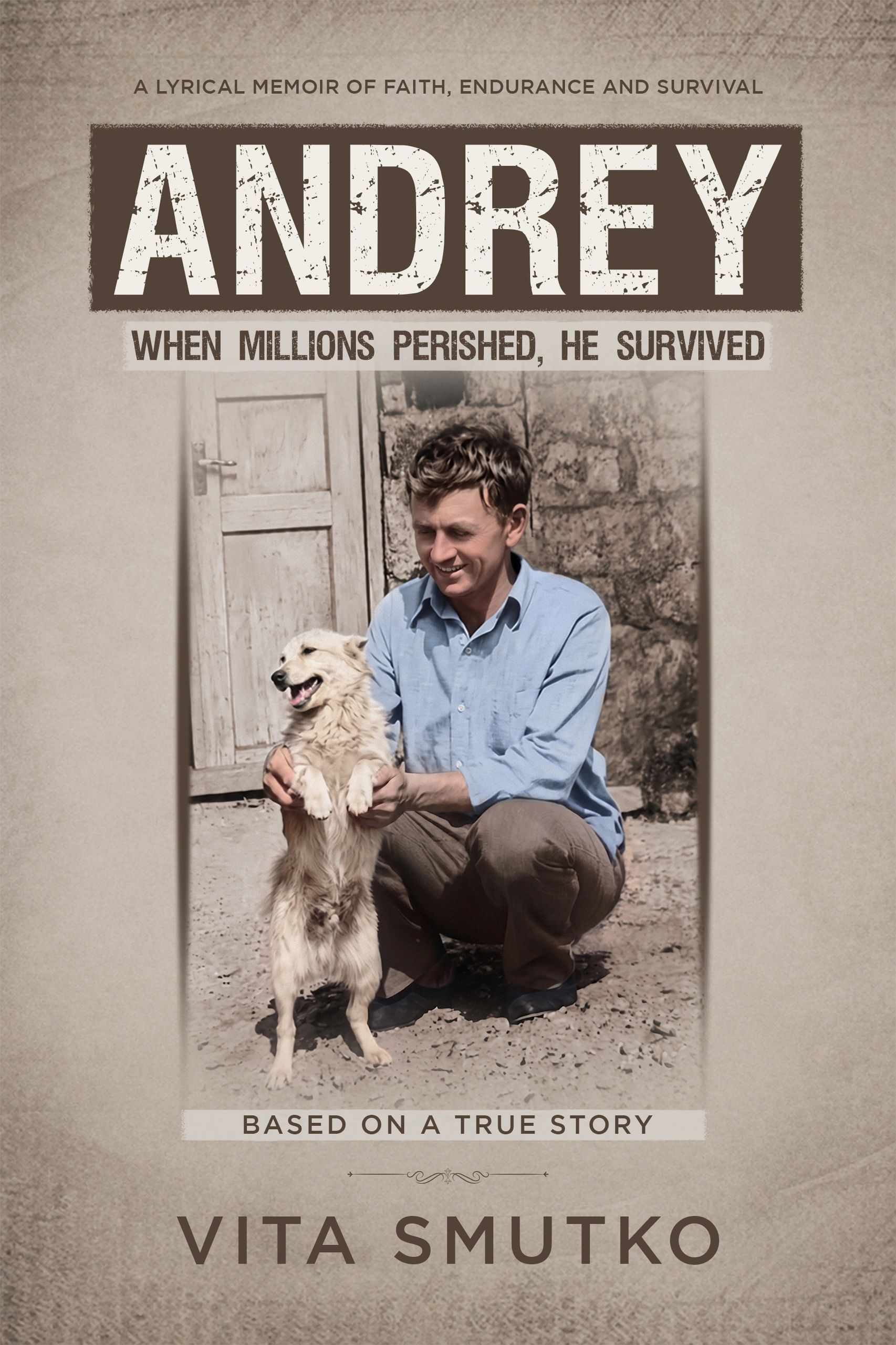
Born in the Republic of Georgia and raised along the Black Sea, she grew up listening to her father’s extraordinary story. Through ANDREY, Vita honors those who endured famine, war, persecution, and the Soviet labor camps while preserving their courage, faith, and humanity for future generations.
My Father's Story
When millions perished, he survived.
Andrey was born on March 5, 1932, in the village of Chaplynka in southern Ukraine, as a man-made famine swept across the land. Before he was old enough to understand the meaning of hunger, he had already witnessed its terrible cost. Food disappeared, families were torn apart, and countless lives were lost. Half of Andrey’s siblings did not survive.
Yet amid suffering and fear, his parents gave him something no authority could confiscate: faith. Their prayers, whispered in secret, planted within him a quiet trust in God that would sustain him through the darkest years of his life.
A Childhood Shaped by War
Andrey’s childhood unfolded beneath the shadow of political oppression and war. He was still a boy when German forces occupied his village during World War II. His family’s home was commandeered, his father was taken to the front, and his siblings were sent away as forced laborers for the Germans.
When the war finally ended, peace did not truly return. The land remained scarred by destruction, unexploded weapons, hunger, and fear. A wartime explosion injured Andrey’s hand, leaving him with a permanent reminder that survival often carried wounds of its own.
Determined to help his family, he left school and began working while still a child. He learned early that endurance was not an idea—it was a daily necessity.
Sentenced at Fifteen
At only fifteen years old, Andrey was arrested for a crime he did not commit.
He was sentenced to fifteen years in Soviet prisons and forced-labor camps. In an instant, his youth, freedom, and future were taken from him.
He passed through overcrowded cells where hunger, illness, humiliation, and violence were part of everyday life. He learned when to remain silent, whom to trust, and how to recognize danger before it arrived. Still only a boy, he was forced to develop the instincts of a man fighting to stay alive.
Eventually, he was transported across the vast Soviet Union to Kolyma, one of the most feared regions of the Gulag system.
The Frozen World of Kolyma
In the remote wilderness of northeastern Siberia, prisoners endured forced labor, starvation, disease, brutality, and temperatures that could fall far below zero. Kolyma was a place designed not merely to imprison human beings, but to break them.
Andrey labored in the frozen landscape with inadequate clothing and little food. He witnessed cruelty that would remain with him for the rest of his life. But he also encountered unexpected acts of compassion—a piece of bread shared, a warning quietly given, or one prisoner helping another stand when his body could no longer carry him.
In a world where nearly everything had been taken from him, Andrey held on to the one thing his captors could not reach: the faith planted in him as a child.
His survival was not a single moment of courage. It was a choice made repeatedly—in hunger, exhaustion, loneliness, and fear—to endure one more hour, one more night, and one more day.
A Life Beyond Survival
Andrey survived famine, war, wrongful imprisonment, and the deadly labor camps of Kolyma. But his story is not defined only by what he suffered. It is also the story of the man he became afterward.
The hardships he endured shaped his strength, his compassion, and his understanding of human nature. They taught him the value of freedom, family, kindness, and faith. Although he carried the memories of those years throughout his life, he refused to allow suffering to have the final word.
For many years, much of Andrey’s story remained within the family. Like so many survivors of oppression, he carried memories too painful—and once too dangerous—to speak about openly.
His daughter, Vita Smutko, eventually began gathering his recollections and placing them within the history through which he had lived. In writing ANDREY: A Memoir of Faith, Endurance and Survival, she became the guardian of a testimony that might otherwise have disappeared.
Andrey’s story now stands as a memorial to those who survived, to those who vanished without graves, and to the generations who must never forget.
It is not only a story of suffering.
It is a story of faith that endured, humanity that survived, and a life that darkness could not extinguish.
Understanding the Gulag
The Gulag
The Gulag was an immense network of Soviet prisons, forced-labor camps, colonies, and detention centers. It became one of the principal instruments of repression under Joseph Stalin, imprisoning millions of people across some of the most remote and inhospitable regions of the Soviet Union.
The following historical facts provide context for the world Andrey entered when he was arrested at fifteen and sentenced to Soviet prisons and labor camps.
What Does “Gulag” Mean?
The word Gulag comes from the Russian acronym ГУЛАГ, referring to the government administration responsible for the Soviet forced-labor camp system.
Although people often use “Gulag” to describe an individual camp, it originally referred to the government agency that administered an enormous network of camps and colonies throughout the Soviet Union.
Millions Passed Through the Camps
Historians estimate that approximately 18 million people passed through the Gulag’s forced-labor camps between 1930 and 1953. Millions of others were subjected to internal exile, forced resettlement, prisons, and labor colonies.
The precise number of deaths remains debated. Soviet records were incomplete, some gravely ill prisoners were released shortly before death, and many victims disappeared without complete documentation. Archival research generally places documented or detention-related deaths in the Gulag system at approximately 1.5 to 1.7 million, while acknowledging that the full human cost extended far beyond official camp records.
Prisoners Were Not All Convicted Criminals
The camps held people convicted of ordinary crimes. They also imprisoned political opponents, religious believers, intellectuals, military personnel, ethnic minorities, former prisoners of war, and citizens accused of disloyalty to the Soviet state.
Some were sentenced after fabricated accusations, forced confessions, or abbreviated proceedings that offered little meaningful opportunity for a defense. A person did not have to commit a genuine crime to be declared an “enemy of the people.”
Forced Labor Served the Soviet Economy
Prisoners were used to mine gold and coal, cut timber, construct railways and canals, build roads, and establish settlements in remote regions.
The camps were therefore more than places of imprisonment. They supplied the Soviet state with a vast and expendable labor force. Prisoners were frequently expected to meet demanding work quotas while weakened by hunger, illness, inadequate clothing, and extreme weather.
Hunger Was a Means of Control
Food rations were often connected to the amount of work a prisoner completed. Those who were too weak to fulfill their quotas could receive less food, leaving them even less capable of working the following day.
This created a deadly cycle: hunger produced weakness, weakness reduced productivity, and reduced productivity brought still greater hunger.
Kolyma Was Among the Most Feared Regions
Kolyma lies in the remote northeastern reaches of the Soviet Far East. Rich in gold and other natural resources, the region became the center of an extensive forced-labor operation administered through Dalstroy.
Prisoners sent to Kolyma worked in mining, road construction, logging, and other forms of exhausting physical labor. Isolation, severe cold, inadequate food, dangerous working conditions, and limited medical care gave Kolyma a particularly terrifying reputation within the Gulag system.
It was to this frozen region that Andrey was eventually transported.
The Journey Could Be an Ordeal of Its Own
Prisoners were commonly transported over enormous distances in crowded railcars, prison vehicles, and ships. Those sent to Kolyma generally traveled eastward across the Soviet Union and then continued by sea toward Magadan, the principal gateway to the region’s camps.
Journeys could last for weeks or months. Prisoners endured overcrowding, insufficient food and water, disease, violence, and uncertainty before they even reached their assigned labor camps.
Camp Conditions Varied—but Suffering Was Widespread
The Gulag was not a single camp, and conditions differed by location, period, work assignment, and camp administration. Nevertheless, survivor testimony and archival records repeatedly document hunger, exposure, exhaustion, disease, violence, inadequate medical care, and degrading living conditions.
The most dangerous years included periods of famine, mass repression, and World War II, when mortality within the camps rose dramatically.
The Gulag Did Not Immediately Disappear After Stalin
Joseph Stalin died in March 1953. Although the Soviet camp system did not vanish immediately, large-scale releases, amnesties, and reviews of prisoners’ cases followed during the 1950s.
Many survivors returned home carrying permanent physical and emotional wounds. Some remained silent for decades because speaking openly about their imprisonment could still place them or their families in danger.
Behind Every Number Was a Human Life
Statistics help us understand the scale of the Gulag, but numbers alone cannot convey its human cost.
Every prisoner had a name, a family, a past, and a future interrupted. Some survived and returned home. Others disappeared into unmarked graves. The testimony of survivors such as Andrey allows history to be understood not merely as a record of governments and institutions, but as the lived experience of human beings who struggled to preserve their dignity in a system designed to take it away.
